Yemen : « The world’s worst humanitarian disaster since WWII »

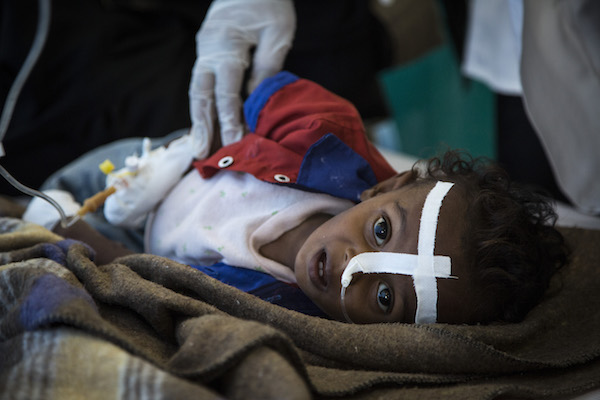
copyrights : Florian Seriex for Action Contre la Faim
5 years of war, a massive blockade, 85% of the population in need of humanitarian aid, 50% of the health structures destroyed. All the humanitarian pathways have now been stopped. After the 15-day ceasefire implemented by Saudi Arabia, the country has just announced its 1st Covid-19 case. Testimonies of 2 humanitarian workers from MDM and ACF
Saudi Arabia announced a 15-day unilateral ceasefire in Yemen. What does this mean on the spot?
Sarah Chauvin: We’re glad there’s a ceasefire announcement. We hope that this will improve access to the population. It gives us hope for a resolution of the conflict, even if the humanitarian aid constraints remain very present.
Jon Cunliffe: In the short term, it means little. The immediate effect is to have fewer strikes for the people who badly need this to be the case. More than the ceasefire, they need an end to the blockade imposed by Saudi Arabia. The ceasefire is only the "first step.”
Do NGOs benefit from a humanitarian corridor to bring aid to Yemen?
Sarah Chauvin: Before the COVID-19 epidemic started, we had huge problems, linked to the blockade, administrative procedures and transportation difficulties. The situation is worsening with the closure of borders of countries like Jordan or Djibouti. We used to help Yemen in this way. We cannot use this options anymore. We need to find new “pathways”. For the moment, we buy few things from the local market. It can be an option, but as you know, a thermometer in the Aden or Sanaa market costs several hundred dollars.
Jon Cunliffe: Despite the blockade, we have always managed the aid, through the port of Hodaida or through the city of Aden. Whatever aid or assistance the UN or NGOs can provide at this time : it won’t be enough to respond to the effect of the war.
What is the situation of the Yemeni population ?
Sarah Chauvin: Only 50% of health structures are still functional. There are very strong risks of epidemics, including cholera which will increase with the rainy season.
Jon Cunliffe: To give you a very simple idea, there are an estimated 400,000 children in food distress and nearly 1.7 to 2 million children suffering from malnutrition. Overall, almost 85% of the population (24 million people) is in need of humanitarian aid in terms of food, water supply or medical care. The medical system has been inoperative for several years.
What do they have to fear with regarding the pandemic situation ?
Sarah Chauvin: We all dread the worst with the coronavirus epidemic, the extent of which is hard to estimate today. We know that sanitary conditions will not allow isolation measures. Don’t forget that the country is also divided in two. In the North, the situation is worsening because of the blockade. The airports in Yemen are closed. By boat, which is the only option, it takes several weeks. They have very few resources. They're going to have outside help. The WHO and the UN are working on it right now.
Jon Cunliffe: The war in Yemen has been going on for 5 long years. It was already the poorest country in the region. The medical capacity is almost at a standstill at he time of speaking to you. In France, the UK or the USA, there are hospitals, medical systems that can provide quarantine measures. That doesn’t exist in Yemen ! I was there in February. I’m a nurse and I have been to many difficult terrains in the world in my life. I have never seen this ! If Covid-19 spreads in Yemen, we will have to face the worst global humanitarian disaster since the Second World War. Worse than in Ethiopia in 1984 !
What can we do to improve the situation?
Sarah Chauvin: We need to end the blockade, so we can allow the arrival of equipment. Our countries can have a voice. We must not forget the impact of solidarity and charity work for this country. For Yemen, the worst is yet to come.
John Cunliffe : We have a huge responsibility for what's going on there ! We are involved , as Western countries, in this conflict. If the war has been going on for so long, it’s because we have sold a lot of weapons there. Take my country as an exemple, the UK. As a global weapons seller, they have risen from the 5th to the 2nd biggest seller of arms sellers in the world. It can say “Thank you” to Saudi Arabia and the United Arab Emirates. We must put significant pressure on our governments to stop selling arms to belligerent countries. They must help us gain access to the population. Stop the blockade ! Let us send authorized airdrops ! We also need money to act. Yemen is a "forgotten" conflict. I don’t even dare imagine the death count if we don’t act.